Table of Contents
There is nothing quite as frustrating as walking into your kitchen only to discover a steady line of ants marching across your countertop. Ants are relentless foragers, and once they find a reliable food or water source in your home, they invite the entire colony. While the immediate instinct might be to reach for a chemical bug spray, many homeowners are turning to safer, more holistic alternatives. If you are looking for a powerful, eco-friendly way to reclaim your home from these tiny invaders, learning how to use essential oils for ants is an absolute game-changer.
Unlike harsh commercial pesticides that leave behind toxic residues and unpleasant odors, essential oils offer a botanical, sweet-smelling defense system. These potent plant extracts have been used for centuries to deter pests, and modern science supports their effectiveness against insects. In this comprehensive guide, we will explore exactly why these natural wonders work, highlight the absolute best essential oils for repelling ants, and provide you with simple, step-by-step DIY recipes to protect your living spaces.
Why Choose Essential Oils for Ant Control?
Before diving into the specific oils that send ants packing, it is important to understand why so many people are making the switch to natural pest control.
Non-Toxic and Eco-Friendly
Traditional ant killers often contain harsh chemicals that can be harmful to the environment, contaminating soil and degrading indoor air quality. Essential oils are derived directly from plants, meaning they break down naturally without leaving a permanent toxic footprint in your home or garden.
Safer for the Family
When you spray chemical pesticides on your kitchen counters, baseboards, or dining areas, you risk exposing your children and family members to harmful neurotoxins. Essential oils provide a much safer alternative for indoor use, particularly in food preparation areas. (Note: Pet owners must still exercise caution, as we will discuss later).
Aromatherapy Benefits
Commercial bug sprays usually smell terrible, forcing you to ventilate your home for hours. Essential oils, on the other hand, make your house smell like a high-end spa, a crisp forest, or a blooming garden while simultaneously doing the heavy lifting of pest control.
The Science: How Do Essential Oils for Ants Work?
To effectively use essential oils for ants, you have to understand how ants operate. Ants are virtually blind; they rely almost entirely on their highly evolved sense of smell to navigate the world. When a scout ant finds a crumb on your floor, it leaves behind an invisible trail of pheromones (chemical scent markers) as it walks back to the nest. This pheromone trail acts like a glowing neon sign, guiding hundreds of other ants directly to the food source.
Essential oils combat this biological process in two distinct ways. First, the incredibly strong, concentrated aromas of essential oils overwhelm the ants’ delicate olfactory receptors. This successfully masks the pheromone trails, leaving the ants disoriented, confused, and unable to find their way back to the food or their nest. Second, many essential oils contain active chemical compounds—like menthol, eugenol, and d-limonene—that act as natural repellents or even insecticidal agents upon direct contact, irritating the ants’ exoskeletons and nervous systems.
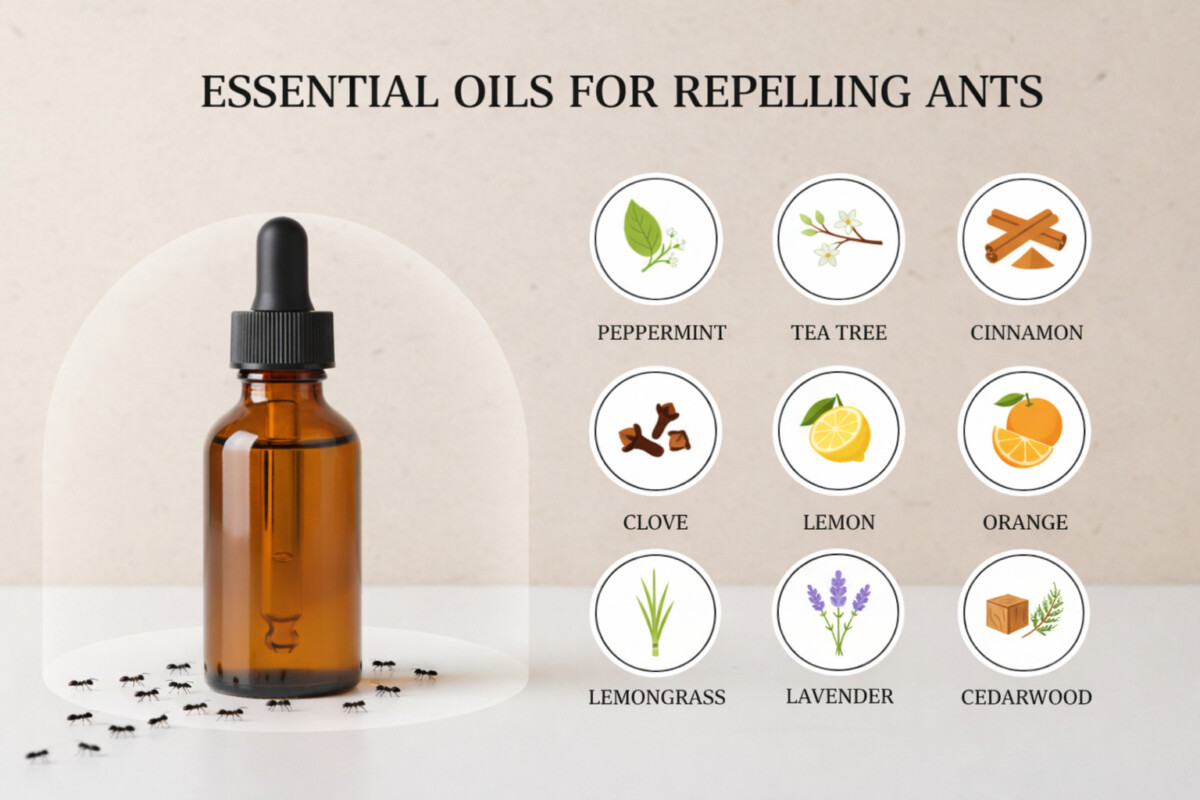
The 8 Best Essential Oils for Ants
If you want to build a natural ant-fighting arsenal, these are the heavy hitters you need to keep in your pantry.
1. Peppermint Essential Oil
Peppermint oil is arguably the most famous and effective natural ant repellent. The secret lies in its incredibly high menthol content. While humans love the crisp, refreshing scent of peppermint, ants absolutely despise it. The menthol is highly irritating to ants and throws off their scent-tracking abilities completely. A perimeter sprayed with peppermint oil acts as an invisible, impenetrable wall that ants simply refuse to cross.
2. Tea Tree Essential Oil
Tea tree oil (Melaleuca) is widely known for its potent antibacterial and antifungal properties, but it is also a highly effective natural insecticide. Its sharp, medicinal aroma conceals ant footprints and interferes with their communication cues. When applied to entry points or cracks in the wall, tea tree oil ensures ants will quickly turn around and seek shelter elsewhere.
3. Cinnamon Essential Oil
You might love sprinkling cinnamon on your morning oatmeal, but cinnamon essential oil is a potent weapon against pests. It contains a compound called cinnamaldehyde, which is highly toxic to ants. While ground cinnamon from your spice rack might temporarily deter them, highly concentrated cinnamon essential oil can actually kill ants on contact and disrupt their pheromone trails permanently.
4. Clove Essential Oil
Clove essential oil is an underestimated powerhouse in the world of natural pest control. It contains eugenol, a fast-acting natural compound that targets the nervous systems of insects. Clove oil acts as both a fierce repellent and an on-contact killer, making it one of the best essential oils for ants when you are dealing with an active, heavy infestation.
5. Lemon and Citrus Essential Oils
Citrus oils—including lemon, sweet orange, grapefruit, and lime—are phenomenal at keeping pests at bay. These oils contain d-limonene, a compound that is toxic to ants and can dissolve the protective waxy coating on their exoskeletons. Furthermore, the zesty, bright scent of citrus easily overpowers ant scent trails, making these oils perfect for wiping down sticky kitchen countertops.
6. Lemongrass Essential Oil
Not to be confused with standard lemon oil, lemongrass contains citronellal and geraniol. These compounds are famously used in commercial products to repel mosquitoes, but they are equally effective against crawling insects. Lemongrass oil leaves behind a sweet, sour, and grassy scent that confuses ants and effectively masks the pheromones they rely on for navigation.
7. Lavender Essential Oil
Lavender is highly prized for its ability to soothe anxiety and promote restful sleep in humans, but to ants, it is highly repulsive. It boasts natural antimicrobial and insect-repelling properties. Because of its gentle nature and pleasant floral aroma, lavender is an excellent choice for keeping ants out of bedrooms, closets, and linen cupboards without overpowering the room.
8. Cedarwood Essential Oil
Cedarwood essential oil brings a rich, woodsy, and grounding scent to your home while acting as a natural fumigant. The strong aroma disorients ants, and the oil itself can be highly drying to their bodies. Cedarwood is a fantastic option to use around baseboards, window frames, and the exterior foundation of your home to create a long-lasting barrier.
How to Make a DIY Essential Oil Ant Repellent Spray
Ready to put these powerful plant extracts to work? Making your own ant repellent spray is incredibly simple, cost-effective, and allows you to customize the scent to your liking. Because oil and water do not naturally mix, you will need an emulsifier (like witch hazel) to ensure the essential oils disperse evenly throughout the liquid.
Ingredients:
- 1 cup of distilled water
- 1/4 cup of witch hazel (or high-proof rubbing alcohol/vodka)
- 1/2 teaspoon of liquid dish soap (this helps the spray stick to surfaces and breaks down the ants’ exoskeletons)
- 20 drops of Peppermint essential oil
- 15 drops of Lemon or Sweet Orange essential oil
- 10 drops of Clove or Tea Tree essential oil
Instructions:
- Pour the witch hazel and liquid dish soap into a clean, empty glass spray bottle (essential oils are potent and can degrade plastic over time).
- Carefully add in your chosen essential oils for ants. Swirl the bottle gently to mix the oils with the witch hazel and soap.
- Fill the rest of the bottle with distilled water.
- Cap the bottle tightly and shake vigorously before every single use to ensure the oils are mixed.
- Spray liberally along baseboards, windowsills, door frames, under the kitchen sink, and directly onto marching ant trails.
Other Effective Methods for Using Essential Oils Against Ants
While a DIY ant spray is highly versatile, it is not the only way to utilize these powerful oils in your home.
The Cotton Ball Strategy
If you know exactly where the ants are entering your home—such as a specific crack in the wall, a gap under a window, or a hole near a pipe—place a cotton ball soaked in 5 to 10 drops of pure peppermint, clove, or citrus oil directly at the entry point. The concentrated fumes will act as an intense barricade. Replace the cotton balls every few days as the scent naturally evaporates.
Aromatic Floor Washing
Ants frequently travel across kitchen and bathroom floors in search of microscopic crumbs. To eliminate their scent trails on a massive scale, add 15 to 20 drops of tea tree, lemon, or pine essential oil to your mop water. Mopping with this infused water will thoroughly erase pheromones and leave your floors gleaming, smelling fresh, and completely protected.
Essential Oil Diffusers
While diffusing essential oils will not necessarily kill ants on contact, running an ultrasonic diffuser filled with peppermint, cedarwood, or lemongrass oil in a pest-prone room can make the environment incredibly hostile and unwelcoming to scouting ants. It acts as an excellent preventative measure.
Crucial Safety Tips for Using Essential Oils
While natural, essential oils are highly concentrated botanical extracts and demand respect. Always test your DIY sprays on an inconspicuous area of your hardwood flooring or countertops to ensure they do not cause accidental staining or discoloration.
Most importantly, be deeply mindful of your pets. Many essential oils—specifically tea tree, eucalyptus, citrus, peppermint, and cinnamon—are highly toxic to cats and dogs if ingested, inhaled in large quantities, or applied to their skin. If you have furry friends at home, consult your veterinarian before spraying essential oils around the house, and always keep pets out of treated rooms until the spray has completely dried and dissipated.
Combine Oils with Good Housekeeping for Maximum Results
Even the best essential oils for ants will struggle to keep pests away if your home offers a free, all-you-can-eat buffet. To ensure your natural repellents work flawlessly, combine them with strict household preventative measures:
- Wipe up spills, sticky spots, and food crumbs immediately.
- Store pantry items like sugar, honey, cereal, and baking supplies in airtight glass or thick plastic containers.
- Empty the kitchen trash can regularly and scrub the inside of the bin to remove sticky residues and odors.
- Seal cracks, crevices, and tiny gaps around windows and doors with silicone caulk to physically block their entry.
Conclusion
Dealing with an ant infestation doesn’t mean you have to subject your household to harsh, foul-smelling chemical sprays. By harnessing the natural power of plant extracts, you can protect your kitchen, bathrooms, and living spaces safely and effectively. Whether you rely on the minty blast of peppermint, the intense spice of clove, or the zesty punch of lemon, utilizing essential oils for ants is a fragrant, eco-friendly way to reclaim your home from pests. Mix up a bottle of DIY repellent today, erase those invisible pheromone trails, and send those tiny intruders marching right back out the door.