Table of Contents
A garden rarely becomes messy overnight.
It happens quietly, in small ways that are easy to ignore.
A few weeds appear and stay longer than they should. A plant grows just a little too far out of shape. Edges soften. Paths collect debris. Nothing feels “wrong” on its own.
But then one day, you step back and notice something has changed.
The garden doesn’t feel calm anymore. It doesn’t feel intentional.
It just feels unkempt.
Here’s the truth most people miss: an unkempt garden is not always a neglected one. In many cases, it’s a garden that lacks structure, balance, and clarity.
Once you understand what causes that messy look, fixing it becomes much easier than you think.
1. Overgrown Plants That Lose Their Shape
One of the fastest ways to make a garden look messy is letting plants grow without control.
Growth itself is not the problem. The problem is when plants lose their defined shape.
Shrubs become uneven. Flowers start collapsing into each other. Vines stretch in random directions. Instead of looking lush, the garden starts to feel chaotic.
This happens because the eye can no longer recognize clear forms.
What fixes it:
- Trim plants regularly instead of waiting too long
- Remove weak, dead, or crossing branches
- Maintain a consistent shape for each plant
You don’t need perfect symmetry. You just need intentional structure.
2. Overcrowded Planting (Too Many Plants in One Space)
At first, a full garden looks beautiful.
Dense planting can feel rich, vibrant, and full of life.
But as plants grow, that density turns into overcrowding.
Leaves overlap. Airflow decreases. Individual plants lose their identity. Everything blends into one visual mass.
This creates what designers call visual clutter.
Instead of looking lush, the garden starts to feel heavy and disorganized.
What fixes it:
- Space plants based on their mature size, not their current size
- Remove or relocate excess plants
- Use negative space to give the eye room to rest
A well-designed garden is not just about what you add. It’s also about what you leave out.
3. Weeds Breaking the Sense of Control
Weeds don’t need to take over your entire garden to make it look unkempt.
Even a few visible weeds can completely change the perception of the space.
They tend to appear in the most noticeable places:
- Along edges
- Between pavers
- Around the base of plants
The issue is not just aesthetic. Weeds signal a lack of control.
They make the garden feel like it’s managing itself instead of being cared for.
What fixes it:
- Do quick, regular weeding instead of waiting too long
- Focus on high-visibility areas first
- Use mulch to reduce future growth
Consistency matters more than intensity here.
4. Messy or Undefined Edges
Edges are one of the most powerful visual tools in a garden.
They define where one area ends and another begins.
When edges are unclear, everything starts to blur together.
Grass creeps into planting beds. Soil spills into pathways. Lines disappear.
The result is a garden that feels unfinished.
What fixes it:
- Create clean, defined borders between lawn and beds
- Use simple edging tools or materials
- Maintain those edges regularly
Even a slightly wild garden can look intentional if the edges are sharp.
5. Too Many Different Styles, Colors, or Plant Types
A common mistake is adding plants based on preference alone.
You see something you like, and you add it.
Over time, the garden becomes a mix of unrelated elements:
- Too many colors
- Too many textures
- Too many styles
Without repetition or consistency, the space feels chaotic.
The eye doesn’t know where to focus.
What fixes it:
- Limit your color palette
- Repeat plant types or shapes
- Group similar plants together
Repetition creates rhythm. Rhythm creates calm.
6. Bare Soil That Makes the Garden Look Incomplete
Empty patches of soil may seem harmless, but they have a strong visual impact.
They make the garden feel unfinished, like something is missing.
They also draw attention in the wrong way.
Instead of highlighting plants, they highlight absence.
What fixes it:
- Add mulch to cover exposed areas
- Use ground cover plants
- Fill gaps intentionally instead of leaving them empty
A covered surface always looks more polished than exposed soil.
7. Too Much Small Decor and Visual Clutter
Decor can enhance a garden, but too much of it does the opposite.
Small items scattered across the space create noise:
- Multiple small pots
- Random ornaments
- Uncoordinated furniture
Instead of adding character, they compete for attention.
The result is a cluttered, unfocused look.
What fixes it:
- Choose fewer, larger statement pieces
- Group items instead of spreading them out
- Remove anything that doesn’t serve a clear purpose
A clean space always feels more intentional than a crowded one.
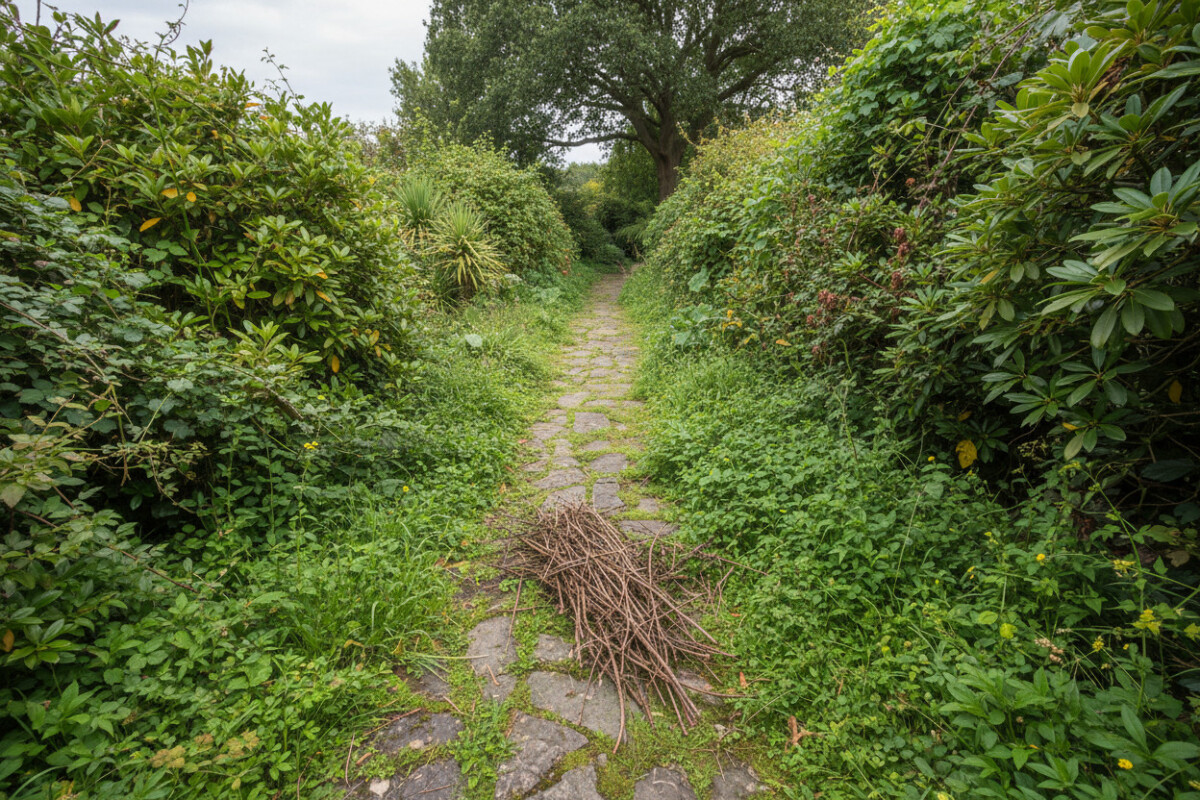
8. Dirty or Neglected Pathways
Paths guide movement and define how a garden is experienced.
When they are neglected, everything feels less maintained.
Common issues include:
- Leaves piling up
- Weeds growing between cracks
- Uneven or stained surfaces
Even if the plants look healthy, messy paths can bring the whole garden down.
What fixes it:
- Clean paths regularly
- Remove weeds as soon as they appear
- Keep edges clear and defined
A clean path instantly improves the entire space.
9. No Clear Layout or Structure
Some gardens look messy even when everything is technically “fine.”
This usually comes down to a lack of structure.
There’s no clear flow. No defined zones. No focal point.
Without structure, the garden feels random.
What fixes it:
- Divide the space into clear zones (seating, planting, pathways)
- Add a focal point such as a tree, feature, or bench
- Use repetition to guide the eye
Structure creates a sense of order, even in natural designs.
10. Poor Scale and Proportion
Scale is one of the most overlooked elements in garden design.
If everything is too small, the space feels busy.
If something is too large, it dominates the entire garden.
When proportions are off, the garden loses balance.
What fixes it:
- Mix large, medium, and small elements
- Match plant size to the size of the space
- Avoid extremes
Balance is what makes a garden feel comfortable to look at.
11. Lack of Consistent Maintenance
This is the underlying cause behind most messy gardens.
Not because people don’t care.
But because maintenance becomes inconsistent.
Small issues are ignored:
- A few weeds stay too long
- A plant goes untrimmed
- Edges slowly disappear
Over time, these small things build up.
What fixes it:
- Create a simple, regular routine
- Focus on high-impact areas first
- Fix small problems early
Consistency always beats occasional effort.
The Real Reason Gardens Start to Look Unkempt
It’s not one big mistake.
It’s multiple small ones happening at the same time:
- slightly overgrown plants
- slightly messy edges
- slightly too many elements
Each one seems minor.
But together, they change how the garden feels.
Final Thoughts
A beautiful garden is not about perfection.
It’s about intention, structure, and balance.
Once your garden has:
- clear edges
- controlled growth
- consistent spacing
- simple structure
…it immediately feels more calm, more organized, and more inviting.
Not because it’s perfect.
But because it looks cared for.